Contact: nikhilrajgupta09@gmail.com

Love in the Supreme Ethics

Friday, 13 March 2015

Domenic Marbaniang: Why Believe God? - Illustration

Domenic Marbaniang: Why Believe God? - Illustration: There are many reasons that a man may give for believing in God. But, I think one of the most personal is the rationale of meaningfulness...

Friday, 27 February 2015

A BOOK REVIEW: Classical Apologetics: A Rational Defense Of The Christian Faith And A Critique Of Presuppositional Apologetics

Book Review : Classical Apologetics: A Rational Defense Of The Christian Faith And A Critique Of Presuppositional Apologetics
Authors: R.C. Sproul, John Gerstner, And Arthur Lindsley
Year: 1984
Pages: 336
ISBN 0310449510

All three authors of this particular effort in apologetics are associated with the Ligonier Valley Study Center. They do not indicate who wrote which sections of the book. However, each author advocates Reformed Christianity. Is it true that a person must accept Christianity on the basis of faith alone? Is there a rational defense of the Christian faith? This is the main ideaof the book by Sproul, Gerstner and Lindsley, namely that Christianity is reasonable and it is rational.
“Classically, natural theology does not stand in contradiction to divine revelation nor does it exclude such revelation. In fact, natural theology is dependent upon divine revelation for its content.” (pg. 12)
The book is divided into three sections:
Sectionone deals with the problems and methods of apologetics. They cover Classical Natural Theology and place it in the crisis of secularism which has worn away at the rational defense of the faith to the “feeling-oriented” appeal to emotional connection. They cover the task of apologetics, the nature of Natural Theology and Fideism, the Biblical evidence to confirm Natural Theology and what we as Christians ought to do to confirm our walk up the mountain of Natural Theology.
Sectiontwo deals with Classical Apologetics in relation to Theistic Proofs, the Deity of Christ, and the Infallibility of Scripture. Here they traverse the theistic arguments for proving God (Ontological, Cosmological and Teleological) with sturdy persuasion and some new understandings. The second was very interesting, and providing a great summary of different arguments, including the ontological, cosmological and teleological arguments for God. This chapter also has chapters dealing with the Spirit and Word of God.
Section three critiques the Presuppositional Apologetics. The authors outline Presuppositional Apologetics, show from history the proponents (Augustine, Luther and Calvin) who held the classical position in variance with Presuppositionalism, and exhibit the starting point of the primacy of the intellect and human autonomy. Next they cover such crucial elements as the Noetic influence of sin, the Self-Attesting God and Analogical Thinking.
It deals with philosophy and apologetics to a greater degree and upholds the classical positioning in contrast to the Presuppositional apologetics made by Cornelius VanTil.
The authors should be enthusiastically applauded for insisting that Christian faith is capable of a reasoned defense. They will not compromise an inch with the destructive idea that heartfelt faith is without intellectual reasons or the idea that to be irrational is a religious virtue. They maintain that God commands believers to reason with unbelievers, not simply proclaim that they must make a groundless, subjective choice. This is a sorely needed emphasis today. We could not agree with it more. On their chosen method of reasoning in defense of Christianity, though, we must agree much less. We must find it, actually, contrary to good reasoning.
The book opens by identifying the object of its apologetical concern: namely, "The Crisis of Secularism" (chap. 1). The central axiom of secularism - and key challenge to Christianity in our day - is the view that "All possible knowledge is restricted to the temporal" (p. 7). Man has an unaided intrinsic ability to reach a knowledge of God, they hold that "natural theology" (the human activity of devising proofs for God's existence) is reflection "dependent upon divine revelation" (p. 25). They tell us that rational apologetics as "pre-evangelism" can establish the cognitive clarification of Christianity and bring the natural man to an intellectual assent, but to take him beyond that to a personal trust in the heart, emotions, and will is solely the work of the Holy Spirit (pp. 21-22).
In the last half of the book, our authors turn to a critique of the presuppositional apologetic, especially as advanced by Cornelius Van Til. According to the authors, Van Til is a "fideist" and, as such, holds that God cannot be known through nature and theistic proof, but only by faith - a faith independent of all rational evidence (p. 27, 34, 35, 185).
I think the way to understand the clash between presuppositional and classical apologetics is to realize that their conflicting claims constitute a strong case for a paradox in the Christian knowledge of God. However,since this is a rather intense read about classical apologetics itnecessitates some contemplation to work thorough. It is an excellent volume on the subject and I heartily recommend this especially to them who have already become familiar with the more critical aspects of apologetics.


Saturday, 14 February 2015

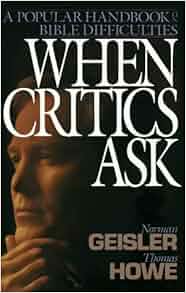
Book Review: When the Critics Ask: A Popular Handbook on Bible Difficulties

Book Review: When the Critics Ask: A Popular Handbook on Bible Difficulties

Authors: Norman Geisler and Thomas Howe
Year: First Edition 1992 by Baker Books
Pages: 600      
ISBN 0-8010-1142-6

Dr. Norman Geisler has written many apologetical books and is a well known scholar and an apologist.  He has a Ph.D. from Loyola University and is Dean of the Southern Evangelical Seminary in Charlotte, North Carolina.  Thomas Howe is an expert in Biblical Languages at the same institution.

In the Preface, Norman Geisler and Thomas Howe support biblical inerrancy by stating that: "The Bible has withstood the criticisms of the greatest skeptics, agnostics, and atheists down through the centuries, and it is able to withstand the feeble efforts of unbelieving critics today." The entire book is an endeavor to proves the same.

They have divided the exhaustive 600 page book into chapters, given to each book of the Bible. With over 800 plus questions, the book also has 3 indices for an immediate and effortless reference. Complex passages or seemingly conflicting passages are discussed, the problem defined, and a clarification given. In the opening chapter they take the observation that the Bible is inerrant since scriptures state that the word of God was given to men to record through inspiration and supervision by the Holy Spirit. Therefore, when troubles come up with interpretation of certain passages, the dilemma lies in context and interpretation, not that the Word is flawed. They have dealt with every book in order, right from Genesis to Revelation.
It offers an excellent resource to counter objections that frequently float up when it comes to alleged Bible inconsistency or fault. I thought the book was well laid out and logical to follow in terms of presentation. I thought that many of the explanations were ample, some were wonderful, a few others seemed to fall a bit short.

While I may not agree with all of the author's conclusions and at the same time many other crucial and controversial passages are skipped. Although they have not covered every single complicated passage with very thorough explanations, I have found the authors' exegesis to be incredibly sound. They reflect on the vital aspects to interpreting a passage, particularly the text's context and historical circumstances. I do assert that this book is not meant to be an all-inclusive overview of Bible difficulties.
However, the language that is used is a very simple layman's style.  If anyone is looking for a high-quality reference book to counter seemingly biblical "contradictions" then this is the book. I discover this book to be of incredible worth in interpreting the scriptures.

At the end I would highly endorse this book for all sorts of readers for couple reasons. First, it’s an amazing book on Bible difficulties for learners and critics both, which give answers to all the key questions, commonly raised. Second, it can also be used as a companion to bible, as a quick commentary. Third, it will also be a great support to strengthen spiritual life of any new believer. Fourth, this is an excellent book on apologetics (basic) so this book will be a "must reading" for anyone who even has a bit of interested in Christian apologetics.


Thursday, 29 January 2015

A BOOK REVIEW: ESCAPE FROM REASON: A PENETRATING ANALYSIS OF TRENDS IN MODERN THOUGHT

ESCAPE FROM REASON: A PENETRATING ANALYSIS OF TRENDS IN MODERN THOUGHT
FRANCIS A. SCHAEFFER
PAGES: 96
ISBN: 0830834052

Francis Schaeffer has been widely recognized as one of the twentieth century’s greatest Christian apologists. Francis August Schaeffer (1912-1984) was an American Christian theologian, philosopher, apologist, and Presbyterian pastor, as well as the founder of the L'Abri community in Switzerland.
In this book Schaeffer has two noble aims; first to analyze the evolution of philosophy from the Christian Middle-Ages up to the Atheist existentialism of Sartre and second to show that Atheism and Mysticism are inadequate before Christianity.
Schaeffer starts off with the rise of modernity (ch.1). Then he moves on with the reformation view (ch.2) before he finally arrives with the birth and characteristics of post-modernity (ch.3) and its impacts in science, art, morality and theology (ch.4-7).
According to Schaeffer it was Aquinas that opened the way for autonomous rationality (in fact the villain of this play is Aquinas). According to Schaeffer, Aquinas claimed that the human will but not human intellect is fallen. This assumption, once popularized, provided the fertile soil for the belief that humans could become independent, autonomous. The outcome was, as Schaeffer puts it, that "nature eats up grace" (p.10), that leads to a modern presupposition of a universe operating under a closed-system excluding any supernatural effects and agents. But Schaeffer aptly describes the problem that "if you begin with an autonomous rationality, what you come to is mathematics (that which can be measured), and mathematics only deals with particulars, not universals. Therefore, you never get beyond mechanics" (p.13).
In first chapter Schaeffer he examines the relationship between ‘grace’ and ‘nature’. He argues that nature has slowly been ‘eating up’ grace. Yet a ‘line’ or ‘gap’ exists between the supposed upper realm of grace and the lower realm of nature. Western society has gone below this line and it has led to despair. This despair is revealed first in philosophy; subsequently, it spreads to art, then music and general culture, before reaching theology.When nature is made autonomous it soon ends up by devouring God, grace, freedom and ultimately man.
In chapter two and three, Schaeffer proposes a history of human philosophy and theology and gives an explanation of contemporary thought, and how to approach it. He traces a line through the renaissance, the reformation, the development of science, Kant, Hegel, Kierkegaard, contemporary existentialism, into contemporary culture. In his analysis of culture he considers the different domains of science, philosophy, and, primarily, the arts.
Furthermore in third chapter, Schaeffer shows how the work of the existentialist philosophers such as Sartre and Heidegger have influenced our society, and indeed the Christian church, more than what most people realize. One of the conclusions that the reader will inevitably draw, after reading this book, is that, in order to be able to successfully present the gospel, we need to truly understand our culture.He repeats his starting point on numerous occasions; namely, that Aquinas's distinction between nature and grace is the source of a dichotomy that has been influencing and destroying culture ever since. On the other hand, his critiques of Kierkegaard and Heidegger are a little bit more interesting, as he shows how these contemporary philosophers have had an enormous influence on our current society.
In fifth chapter Schaeffer contends that since man has failed to unify experience in nature and since also modern man has long since abandoned "grace" or "heaven" or "Scriptures" as the principle of experiential (i.e. existential and ontological and epistemological) unification, he has nothing left but despair. So now, man is trying mysticism, pornography, drugs, death and other forms of ways to 'leap' into something else that can provide meaning. Modern man has given up on dualism. The universe is not rational, it is an impersonal machine and man a part of that. But man is a personality and personhood according to Schaffer cannot be found in a mechanistic universe.
As per my opinion Aquinas taught that there are things that can be known from the light of reason. This is of course, self-evident and it is even biblical (see Romans 1:20 where St. Paul even asserts that the existence of God can be known from the knowledge of created things, so that all have knowledge of God, even those without Divine Revelation in the Scriptures). So Schaffer is a bit mistaken here from a biblical point of view.

Overall despite of this flaw, it’s a wonderful read. Single most pivotal aim is,perhaps he says it best at the conclusion of the book, “Every generation of Christians has this problem and responsibility of learning how to speak meaningfully to its own age" (p.5). "What is said in this book is not a matter of intellectual debate. It is not of interest only to academics. It is utterly crucial of those of us who are serious about communicating the Christian gospel in the twentieth century" (p.67).
Tuesday, 18 November 2014

Domenic Marbaniang: Couplets (Dohas) by Rahim and Kabir With English M...

Domenic Marbaniang: Couplets (Dohas) by Rahim and Kabir With English M...: Khanzada Mirza Khan Abdul Rahim Khan-e-Khana (17 December 1556 – 1626) (Hindi: अब्दुल रहीम ख़ान-ए-ख़ाना, Urdu: عبدالرحيم خان خانان), a...

Wednesday, 5 November 2014

Domenic Marbaniang: "Blessed Are Those Who Mourn" - The Need of the Ho...

Domenic Marbaniang: "Blessed Are Those Who Mourn" - The Need of the Ho...: In Matthew 5:4, Jesus declared the Second Beatitude: "Blessed are those who mourn, for they shall be comforted." I think that...

Tuesday, 28 October 2014

Domenic Marbaniang: Pastor, How Can I Get Married? ~ Simple Living

Domenic Marbaniang: Pastor, How Can I Get Married? ~ Simple Living: Drunken Young Man: Pastor, how can I get married; by praying or by fasting? Pastor: Not by praying nor by fasting, but by proposing....

Tuesday, 30 September 2014

A Book Review: The Discovery of Genesis: How the Truth of Genesis Were Found Hidden in the Chinese Language

Kang, C.H. and Nelson, Ethel R., The Discovery of Genesis: How the Truth of Genesis Were Found Hidden in the Chinese Language
Pages 154
ISBN 0570037921
“Who (God) in bygone generations allowed all nations to walk in their own ways, nevertheless He did not leave Himself without witness” [Acts 14:16-17]. Indeed, these verses resound again and over again through the reader’s mind when we take Kang’s work into perspectives. This was the product of long laborious endeavor of a man committed to contextualize gospel to Chinese land.  His proof for God of Bible in Chinese Graphology is incontrovertible.

The author Reverend Kang is a native Chinese, who through his hard work discovered the truth many years ago. Ethel R. Nelson is an American missionary who was so intrigued by an earlier publication by C.H. Kang that she urged him to partner with her to go into more detail.

With the help of a flexible publisher and a talented calligrapher, they unfold the history of mankind from creation to the Tower of Babel from this written language that predates the ld Testament. Kang explicitly, through his amazing deconstruction of alphabets and demonstrates that how the elemental chunks of numerous ancient Chinese characters audaciously echo the tales concerned with that of Adam and Eve, institution of marriage, Serpent, the fall, the Great Flood, the Tower of Babel and many other Genesis accounts recorded in the Bible. Through author’s Linguistic analysis of Chinese language character, he claims that the ancient Chinese were of Abraham’s descend. Author believes that earliest Chinese were actually remnant of Babel’s dispersion. And the ancient worshippers in China were actually monotheistic and knew the Abrahamic God of Bible.

A brilliant research and a ground breaking work that is plausible to administer possible bridges for interfaith dialogue amongst adherents of Chinese worldview with that of Biblical. Intriguing!

From a critical look, we also must not forget the historical formation of Chinese characters actually had been under much evolution till its modern widely accepted form. So the modern Chinese reader might find it somewhat inconceivable at times.

Nevertheless, I invincibly recommend this read for couple of reasons; first, because it’s an exotically extraordinary work. A foreigner to Chinese language, like me will find the book understandable because of its excellent sidebar graphics, it’s clear and concise. Second, I believe it will be a great tool for the missionaries to China who are interested in Contextual apologetics. Because book will convince a Chinese that Christianity is not an antipodal belief, instead, a historical reality well embedded in his very own culture and own ancient language. Finally, it’s a fascinating read for every Christian to explore more extended validity of Genesis account on initial humanity, coming from a non-Christian context.

Read Bible, especially Genesis, then read this book. And then you will be surprised! What a great message! 


 Further Reading 


Thursday, 25 September 2014

A Book Review: When the Critics Ask: A Popular Handbook on Bible Difficulties

When the Critics Ask: A Popular Handbook on Bible Difficulties
Authors: Norman Geisler and Thomas Howe
Year: First Edition 1992 by Baker Books
Pages: 600      
ISBN 0-8010-1142-6

Dr. Norman Geisler has written many apologetical books and is a well known scholar and an apologist.  He has a Ph.D. from Loyola University and is Dean of the Southern Evangelical Seminary in Charlotte, North Carolina.  Thomas Howe is an expert in Biblical Languages at the same institution.

In the Preface, Norman Geisler and Thomas Howe support biblical inerrancy by stating that: "The Bible has withstood the criticisms of the greatest skeptics, agnostics, and atheists down through the centuries, and it is able to withstand the feeble efforts of unbelieving critics today." The entire book is an endeavour to prove the same.

They have divided the exhaustive 600 page book into chapters, given to each book of the Bible. With over 800 plus questions, the book also has 3 indices for an immediate and effortless reference. Complex passages or seemingly conflicting passages are discussed, the problem defined, and a clarification given. In the opening chapter they take the observation that the Bible is inerrant since scriptures state that the word of God was given to men to record through inspiration and supervision by the Holy Spirit. Therefore, when troubles come up with an interpretation of certain passages, the dilemma lies in context and interpretation, not that the Word is flawed. They have dealt with every book in order, right from Genesis to Revelation.
It offers an excellent resource to counter objections that frequently float up when it comes to alleged Bible inconsistency or fault. I thought the book was well laid out and logical to follow in terms of presentation. I thought that many of the explanations were ample, some were wonderful, a few others seemed to fall a bit short.
While I may not agree with all of the author's conclusions and at the same time, many other crucial and controversial passages are skipped. Although they have not covered every single complicated passage with very thorough explanations, I have found the authors' exegesis to be incredibly sound. They reflect on the vital aspects of interpreting a passage, particularly the text's context and historical circumstances. I do assert that this book is not meant to be an all-inclusive overview of Bible difficulties.
However, the language that is used is a very simple layman's style.  If anyone is looking for a high-quality reference book to counter seemingly biblical "contradictions" then this is the book. I discover this book to be of incredible worth in interpreting the scriptures.

At the end, I would highly endorse this book for all sorts of readers for a couple reasons. First, it’s an amazing book on Bible difficulties for learners and critics both, which give answers to all the key questions, commonly raised. Second, it can also be used as a companion to the bible, as a quick commentary. Third, it will also be a great support to strengthen the spiritual life of any new believer. Fourth, this is an excellent book on Apologetics (basic) so this book will be a "must read" for anyone who even has a bit of interested in Christian Apologetics.


Further Reading